

What’s the benefit?
What’s the point, it’s never sunny in the UK?
You’d be surprised! Solar panels are now far more efficient than they used to be!
The UK has some of the highest electricity costs in the world. Solar gives you the opportunity to harness free energy, directly from the sun. Solar panels can still generate electricity on overcast days. In fact, although you will see a decrease in generation over the winter, smart systems along with batteries can still make a huge impact to your bill.
Below are some of the most commonly asked questions about solar. If you still have a burning query, feel free to drop us a message and we’ll get back to you with a no-nonsense, no-hard-sell answer.

-
Savings vary because every home uses electricity differently. The big driver is how much of your solar you can use in the moment, because power you use at home is usually worth more than power you export.
That’s why we don’t guess. We model your roof and likely generation, then match it to your day-to-day usage so that the estimate is realistic rather than a generic “average home” number.
If your roof orientation or shading means the payback is weak, we’ll say so up front, because the worst outcome is a system that looks good on paper but disappoints in real life.
-
Yes. Panels generate from daylight, so they still produce power when it’s overcast.
What changes is the output level. Cloud cover reduces intensity, so generation is lower than on bright days, but it’s rarely “nothing” unless it’s very dark.
A well-designed system focuses on the times you use energy most, so the day-to-day benefit still feels consistent even in typical UK weather.
-
The right size is the one that fits your roof and your lifestyle. It’s mainly driven by your annual electricity usage, your available roof faces, shading and whether you want a battery now or later.
Bigger is not automatically better. If you install more generation than you can sensibly use or export, you pay more up front without getting a matching benefit back.
We size systems to be practical, then show you what changes if you go smaller or larger so you can choose with confidence.
-
Most quality panels are built for long service, and it’s normal to see warranties that run for decades. We provide 10-year workmanship warranty, 30-year mounting warranty and 25-year panel warranty, as standard.
Over time, panels usually degrade gradually rather than failing suddenly, so they keep working but produce a little less each year. However, we only install panels that promise 88% or more efficiency after 30-years.
In practice, the installation quality matters as much as the hardware. A tidy, well-protected install with correct roof fixings and proper electrical protection is what keeps systems reliable long-term.
-
In most cases, no. Domestic solar is often covered by permitted development rules, as long as the installation stays within certain limits and conditions. We will design your system within those limits.
There are exceptions, especially for listed buildings and some conservation area situations, so we treat each install as unique rather than an assumption.
-
Not when the roof is suitable and the system is installed properly. The risk is almost never “solar panels” in general; it’s poor fixing methods, poor weather sealing, or fitting onto a roof that already needs work.
Part of doing this professionally is being honest if your roof isn’t ready. If it needs repair or is near end-of-life, it’s usually smarter to address that before panels go on.
Accidents do happen and if there was one during an installation, we are fully covered and insured to make sure you’re not out of pocket.
-
Yes. In the UK, export payments are typically done through the Smart Export Guarantee (SEG), where you’re paid for metered electricity you export to the grid.
Rates and terms vary by supplier, and you can choose a SEG tariff that isn’t necessarily the same as your import supplier.
Your installer must provide an MCS certificate once installed to be able to do this though. We arrange all permits and proof of MCS ourselves. For every install. No exceptions.
-
Sometimes, but it’s not guaranteed.
What solar reliably does is lower running costs and make the home feel more future-proof, which can help with buyer appeal.
The biggest value tends to come from a neat, well-documented install and one that’s easy to understand, maintain, and insure.
It does have a significant impact on your EPC rating.
-
They can generate, but in the UK they’re usually a poor use of money compared with south, east, or west. The Energy Saving Trust specifically advises that north-facing roofs are generally not recommended because you won’t get enough sunlight to make it worthwhile.
If someone has a very specific layout, low-cost additional roof space, or a strong reason to capture late-day summer light, there are edge cases, but it needs proper modelling rather than hope.
We can and do undertake an assessment of all sides of your roof. If you asked, we’d give an option for Summer-Boost panels on the north side - only if we believed it was value for money!
-
With a standard grid-tied solar system, your inverter will shut down when the grid goes down. That’s a safety requirement, because it prevents your system from back-feeding electricity into the network while engineers are working on it.
If you want power during an outage, you need a system designed for it, usually with a battery and a backup, or EPS function that isolates selected circuits from the grid and supplies them safely.
Solar Panel FAQs
-
A battery saves you money by letting you use more of your own energy at the time you need it, especially in the evening. It can also save money by charging from cheaper, off-peak electricity on the right tariff, then using that power later.
The honest answer is that savings depend on your usage pattern, your tariff and how the battery is programmed. We base the recommendation on your actual data so you don’t end up paying for a battery that mostly sits there.
-
Battery size depends on what you’re trying to achieve. Some people want evening coverage, others want tariff shifting, and some want backup for essentials.
We size batteries around your typical evening and overnight usage, your solar generation profile, and your inverter limits, then sanity-check it against budget and payback so it stays sensible.
-
Only if the system is designed for backup. Many batteries are installed purely for self-consumption and tariff savings, and they will still shut down when the grid goes down unless there’s a backup function and correct isolation in place.
If backup matters to you, we design it intentionally for that purpose. Again, this needs to be designed for your needs and wants. At Eboracum Energy Studio, we pride ourselves on designing the correct system, not just a copy and paste one.
-
No. A battery can still be worthwhile without solar if you’re on a tariff with cheap off-peak rates and higher peak rates, because the battery can charge cheaply and discharge when electricity costs more.
Solar simply gives the battery more opportunities to fill up with your own energy rather than buying it from the grid.
-
Home batteries don’t usually “die” suddenly. They gradually lose capacity over time, meaning they store a bit less energy each year.
A typical lifespan is often around 10 to 12 years, depending on the battery and how it’s used, and that’s why we pay attention to the warranty terms and the expected remaining capacity at the end of the warranty.
-
It can contribute, but “directly” depends on the system design and what else is happening in the house at the time. In most homes, the battery and EV charger both draw from the same household supply, with the inverter deciding how much power the battery can provide.
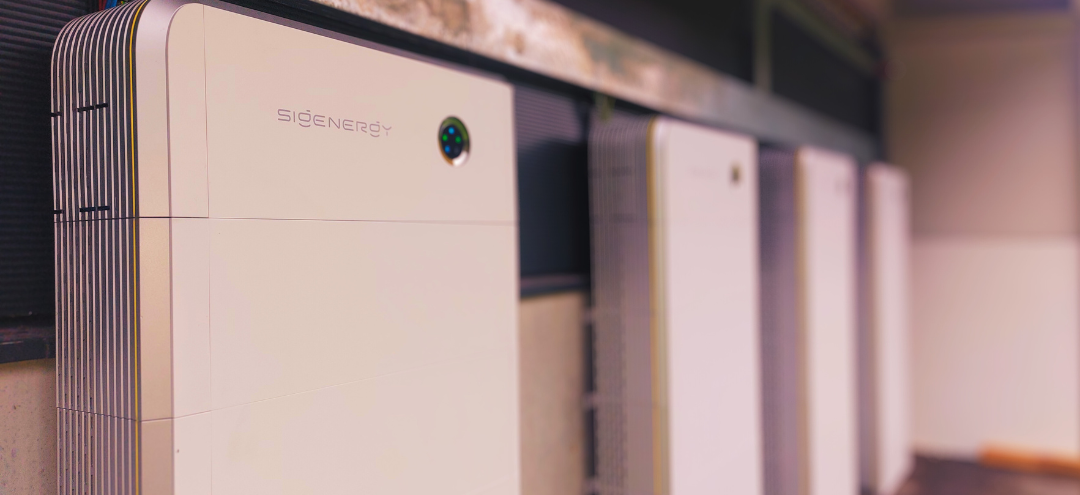
Our preferred system Sigenergy, which is a world leader in EV Rapid Charging. Check our Products page for more information.
-
No. Compatibility matters because the battery and inverter need to communicate properly, and electrical limits have to match, especially on hybrid systems.
We only specify combinations that are proven compatible, supported, and properly warrantied.
-
Sometimes, but it depends on two limits: how much energy the battery stores (kWh) and how much power it can deliver at once (kW). High-demand appliances like electric showers, ovens, and some heat pumps can exceed what many home batteries can supply continuously.
If you want “whole-house” capability, we design for it deliberately, or we design essential-circuits backup so you get a predictable, safe level of resilience without overspending.
For battery safety, it also matters where and how the battery is installed, which is why government safety guidance focuses heavily on risk management and correct installation practices.
Battery Storage FAQs
-
For most households, a standard home charger speed is enough to refill overnight, which is why single-phase home charging is commonly used. The right choice depends on your daily mileage, how long the car is typically parked at home, and whether you’re charging one or two EVs.
UK guidance categorises standard AC home charging up to 7 kW on single-phase supplies, with faster AC charging typically requiring the right electrical supply and equipment.
Our specialist 25kw DC charger is available to Sigenergy customers.
-
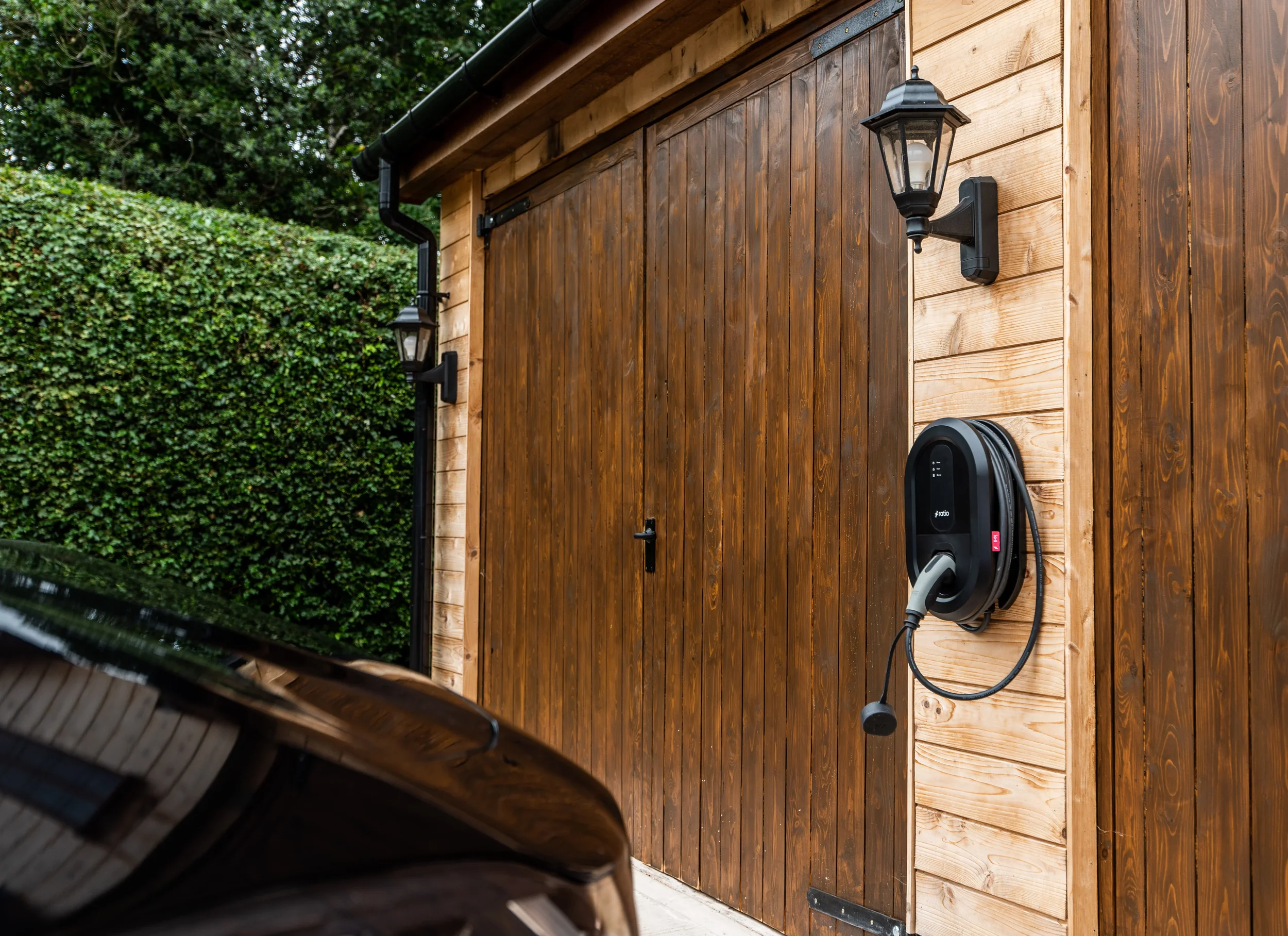
A tethered charger has the cable attached, so you just pull it out and plug in. An untethered charger has a socket, so you use your own cable.
Tethered is often more convenient day-to-day. Untethered can look tidier and is flexible if you change cars or need different cable lengths.
-
Yes, with the right charger and monitoring. Solar integration usually means the charger can automatically adjust charging power to use surplus solar instead of exporting it.
If you also have a battery, we set priorities so you’re clear on what comes first, because some households want the battery filled for evening use, and others want the car to soak up the solar.
-
Not always, but it’s common to need checks, and sometimes upgrades, especially if the consumer unit is old, earthing needs improvement, or the existing supply is already close to its limits.
Modern chargers also include smart functionality requirements, which helps prevent overloading by controlling charging in response to household demand and grid conditions.
All of our installs include any works that may need to be done in a potential quote. No-one wants a nasty surprise on installation day.
-
A straightforward install is usually done in a day. If cable routes are difficult, the consumer unit needs changes, or the job needs additional DNO steps, it can take longer.
We confirm what applies during the survey so you’re not surprised on install day.
-
If you have off-street parking, you can usually install a home charger under permitted development rules, provided it meets the relevant conditions.
If you rely on on-street parking, planning rules are different and you may need permission, especially if cables would cross pavements or the charger isn’t within your curtilage.
-
No. A 22 kW AC charger typically requires a three-phase electricity supply, which many UK homes do not have.
Even if you fit a 22 kW unit, your car also has to support charging at that rate on AC, otherwise it will charge at the car’s maximum instead.
However, 25kw DC can be supported by a single phase home (which most homes are). However, it will draw power only from the home battery system.
-
A standard EV charger cannot power your home. Powering the home from the car is called bi-directional charging, often described as V2H or V2G, and it requires a compatible car and a compatible bi-directional charger.
In the UK it exists, but availability is still limited and often tied to specific hardware, standards, and trial or early-market setups, so we treat it as a “design for the future” option rather than something to promise as standard today.
Please do check if your car supports V2H or V2G as we specifically design systems to cater for this.
EV Charger FAQs
Get in touch
Not answered your question?
Let us know; we’ll do our best to get back to you with an answer as quickly as possible!